Industry Business Advisor — J. J. Keller & Associates, Inc.
ELDs Explained: The Smart Way to Stay Compliant and Efficient
The importance of ELDs goes far beyond compliance. They're the backbone of safer roads, smarter operations, and stronger accountability.
Published On: 01/22/2026


Written by:
Tim Adam
Electronic logging devices (ELDs) have transformed the trucking industry from paper logs to precision tracking, but their importance goes far beyond compliance. They’re the backbone of safer roads, smarter operations, and stronger accountability. In an era where efficiency and safety define success, understanding why ELDs matter isn’t optional—it’s essential.
An electronic logging device (ELD) is a federally mandated piece of technology that connects to a commercial motor vehicle’s engine to automatically record hours of service (HOS), engine data, mileage, location, and driver identification. Designed to replace paper logs and make driving records tamper-resistant, ELDs enhance data accuracy and safety on the road.
How they work
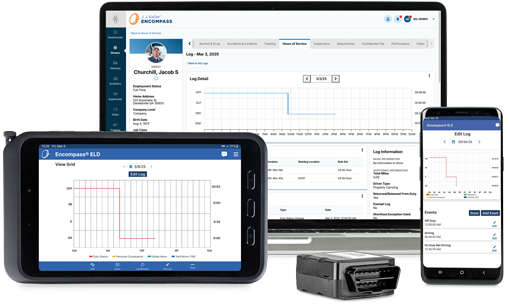
ELDs plug into the truck’s diagnostic port and pull data such as engine on/off status, movement, and miles traveled. They use GPS navigation to confirm locations at all times. When driving begins, the device automatically logs the duty statuses of “Driving” and “On-duty not driving” based on engine and motion signals. The driver must manually input any “Off-duty” and “Sleeper berth” time. Drivers interact using a digital display to log in, switch statuses, annotate events, and view logs.
When they’re required
Under the Federal Motor Carrier Safety Administration (FMCSA) ELD mandate, vehicles with actual or rated weight of 10,001 lbs. or more, vehicles of any weight transporting hazardous materials requiring placards, and commercial buses must use ELDs in interstate commerce. Exemptions include:
- Short-haul operations (within 150 air-miles, returning within 14 hours),
- Pre-2000 model-year trucks,
- Driveaway-towaway transports, and
- Drivers who use paper logs fewer than eight days per 30-day cycle.
Why use them?
There are many benefits to carriers using ELDs. Automated logs improve HOS compliance, result in fewer errors, and lower fatigue-related risks. Replacing paper logs can reduce administrative time and offer real-time data to optimize routing and planning. Driver behavior can be analyzed based on fuel usage and idle time.
Which ones to use
Carriers can only use devices that are on currently on the FMCSA’s ELD list.
The FMCSA has removed 8 ELD providers for technical non-compliance since December 30, 2025. Fleets that were using those ELDs must replace the revoked ELDs to avoid “no record of service” compliance violations.
Other compliance details
To be compliant, carriers also have to meet some other requirements. Each vehicle must have a user manual to show law enforcement how to use the device. Paper logs must be in the vehicle so that, in the event of a malfunction, a driver can begin paper logs to remain compliant. The malfunction must be repaired within 8 days.
Carriers must retain evidence of this data for 6 months. This evidence will include not only the logs, but supporting documents to validate the logs. Record retention applies to all logs, electronic or paper.
Using the right provider is key to remaining compliant. Avoid companies that were affected by revocation and check the FMCSA list regularly. Only consider vendors with clear data transfer policies, tamper resistance, timely updates, and strong customer service. Evaluate GPS accuracy, in-cab alerts, analytics, and mobile functionality.
Ensure the provider supplies comprehensive manuals, malfunction processes, and driver support materials.
An ELD is much more than mandated compliance. It's a comprehensive tool for safer and smarter fleet operations. Stay informed about FMCSA revocations, prioritize certified vendors, and invest in devices that offer both regulatory peace of mind and operational advancement.
Try J. J. Keller's Quick Comply Program
Are you looking to change your ELD provider? We make it easy with our Quick Comply program. Plus, get a 60-day trial of the Encompass Fleet Management Platform.
You may also enjoy the following articles:
Sign up for our newsletter!
We'll help you stay on top of regulations, best practices, and fleet industry news. Sign up to receive a monthly email notification with links to our most recent blog articles, free resources, and event invites.